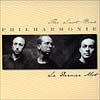
 PHILHARMONIE LE DERNIER MOT / THE LAST WORD CUNEIFORM RUNE 134 1999
Lineup: Frederic L’Epée (guitar), Bernard Ros (Warr guitar), Volodia Brice (drums)
“While most of the post-Crimson prog contingent was busy exposing the subtle mathematical variations of Robert Fripp’s Guitarcraft, Philharmonie were composing these wonderfully melodic instrumentals that virtually blossomed with each new bar or turn of note. Although the Frenchmen shared many traits with Fripp’s numerous ambient and rock undertakings, both approaches couldn’t be more different – while Robert was solving arduous physics equations, Philharmonie were writing haiku. Their fifth and final disc…”The Last Word,” was recorded posthumously last year, several months following their official break –up. The album’s completion was not only as an act of closure on a band that deserved broader recognition, but also served as a clearing out of unrecorded material and solo pieces…. If only more bands had these sort of leftovers. …If there ever was a dominating feature in Philharmonie’s subtle technique, the emphasis on melody always overstruck the notion of complexity or dissonance usually associated with the form. …it was a classy distinction among all the thrak attacks….Sadly, never more.”
– Richard Proplesch, Focus Magazine, #128, June 24-July 7, 2000
“This is not a bunch of half-baked leftovers and live scrapings like the final Echolyn or Anglagard albums. This is the real deal, and without a doubt their best release ever. …they saved all of their best material for this release. The opening track, “Rondo Argentin,” goes way beyond the Philharmonie of old, merging that ethereal moodiness so prevalent on their first album with a new spirited energy… But even that won’t prepare the listener for the very Crimson-like “Metamorphose” – this sucker flat-out screams: this is the kind of music Crimson should be making instead of wasting time on all these half-power Projeckts. … For Philharmonie, their last word is definitely their finest.”
– Peter Thelen, Exposé, #19, May 2000
“…beginning with mathematical precision and reminding in places of Brand X, this guitar-based trio (now duo) has been compared to Fripp’s League of Craft Guitarists. …The Fripp comparisons can be heard of ‘Metamorphose’, a breathtaking piece. The music is hypnotic with a ‘silk and satin’ ambiance with Ros’s evocation of ‘Autumn Rain ‘ nothing short of brilliant….Complex but far from soulless, elsewhere this music has been described as wonderful – and it is! What a loss...if this really is the last word!”
– Phil Jackson, Acid Dragon, #25
“Although rockier, Le Dernier Mot arches back to the wonderful Nord… complex, full of emotion, inventive. …If every band’s swan song was as good as this, the history of rock music would be a lot more interesting. Rating:= 4 stars”
– Françoise Couture, All Music Guide, www.allmusic.com
“…the group makes unforgettable and beautiful guitar-based art-rock. …in the vein of Adrian Belew-era King Crimson. …This trio focuses on the two, avant garde guitarists creating elaborate ostinato and sonic construction of Byzantine counterpoint. Much of this material could be described as pocket-symphonic poems for modern guitar trio.”
– Tom ‘Tearaway’ Schulte, Survivor, Sept. 1999
“For lovers of Frederic L’Epee’s avant-garde guitar style, this final release by Philharmonie, one the best French progressive bands of the 90s, clocks in with some fairly robust songs…”Rondo Argentin”…is a full-blown exercise in subtle South American pampas rock, with stray bits of jazzy lead guitar that sound distant…yet brilliant. On “Bruine (Autumn Rain)” Philarmonie ventures into some interesting territory: Distorted guitar melts into descending bass lines to create a dreamy, existential ambiance.”
– T. J. McGrath, Dirty Linen, #86, Feb/March 2000
“A development on the previous album RAGE it’s a complex lively music that scuttles around with King Crimson like dexterity, yet is fresh and very 90’s sounding…. For those that love this sort of instrumental virtuosity and invention, this CD is sure to delight those that get pissed-off by Adrian Belew’s vocals in 80’s and 90’s King Crimson. Here, all you get is the music!”
– Alan Freeman, Audion, #42, Spring 2000
“Philharmonie is a trio of French musicians that has managed to successfully and gracefully bridge the space between guitar rock, jazz-fusion and progressive melody with minimalistic elements and touches. Their instrumental complex sound is the spirited marriage of free-form expressive fusion and technical sophistication. ..keys to an elaborate maze full of surprises, retracings and resolution. An extremely interesting release.
– Stavros Moschopoulos, FAO Casa Gazette, October 1999
“The Tone Clusters Top 40 and Then Some Best Records of 1999: #43= Philharmonie – A Dernier Mot – Cuneiform-USA
– Tone Clusters, #75, Mar/April 2000
“This final album was…a last testimony to their exceptional compositional and playing skills. …By Le Dernier Mot, Frederic has changed the Philharmonie line-up slightly. …The result is a crossover between the avant-garde R.I.O. sound and the Kind Crimson guitar-based prog-fusion. This is complex and thought-provoking music.…. ‘Le Dernier Mot’…sees Philharmonie in top form. In a way it incorporates everything good about the band – fast and intricate sections with guitars hammering along at tremendous pace, intertwined with quiet ambiance where the instruments are hardly being played at all but still manage to generate an effective sound. …Listening to this album, I am just a little upset with the musical world in general. …I, for one, am glad that there are always those people who are willing to sacrifice success for art – and produce good music against the odds.”
– Frank Blades, Alternative View, 2000, in Rockhaven, http://prog.rickhaven.co.uk
“This is a fine prog album., and should stand as a great monument to the band.”
– Gary Hill, Music Street Journal, www.musicstreetjournal.com
“…they created a very enjoyable, harmonious instrumental sound with elements from jazz, prog rock, classical; music and avant garde. …Try to imagine a rich mix of the calmer moments of the Mahavishnu Orchestra with some Univers Zero and Birdsongs of the Mesozoic thrown in and you get a fair idea of Philarhmonie’s musical abilities. Recommended to jazz rock connoisseurs.
– Louis Behiels, Crohinga Well, October 2000
----------------------------------------------------------------------------------
 PHILHARMONIE RAGE CUNEIFORM RUNE 84 1996
Lineup: Frederic L’Epée & Laurent Chalef (guitars), Bernard Ros (Chapman Stick), Jean-Louis Boutin (drums)
“Imagine Robert Fripps’s League of Crafty Guitarists consisting of three or four Fripps and cross them with the Duritti Column’s equally succinct guitar, laced with classical overtones and you’ve got some idea of what Philharmonie are like. Speaking as a huge fan of both Fripp and the Durrittis, to say that Philharmonie on current evidence surpass both is some compliment….
..they’re a French four-piece…It’s not uncommon to hear three our four guitar lines at once – a recurring theme is to introduce one guitar line, then intertwine it with two or three others, gradually building up the piece into a crescendo. Then.. slow the piece down again…
Fripp provides the easiest reference point because the tortured electric solos, the atmospherics and the layers of acoustic arpeggios heard here are all techniques he pioneered... But Philharmonie often take things one stage further with a very real vision of space, dynamics and classical construction. …Whatever they do is blended together by a very cohesive unit. The band simply oozes class.
… Rage’ is by all accounts a little heavier than any previous material… But that’s not to denigrate ‘Nord’, whose main theme ‘Vers le Nord’ is as beautiful a guitar theme as you could hope to hear. …
Without doubt the best music I heard in 1996.”
– Phil Howitt, Facelift, #17, Jan. 1997
“…here’s a hearty recommendation for serious Frippheads to search for this CD of Crimson-inspired instrumental interplay. …In a radical departure in attaining a more aggressive sound, Philharmonie’s fourth album is a full-blown, rock spectacle that assimilates their overlapping, three-part tradeoffs (a neat tape loop-inspired effect) with King Crimson’s prog dynamics. ..for insatiable Fripp fans...this release sound like their hero without many of his limitations.
While a lot of Crimson’s work is based on Fripp's quick, repetitive riffs the guitarist Adrian Belew colors with...soloing and popish vocals, Philharmonie work more with slight modulations and intonations in these all-instrumental excursions…. Give Philarmonie the edge when discussing versatility and deeper song structure (especially with Crimson’s current predilection for free-forms”….Philharmonie sounds like the post-Red unit that Fripp should have assembled instead of then traipsing off with David Bowie and Darryl Hall. 4 stars”
– Richard Proplesch, Jam Magazine, August 16, 1996
“Remarkably intricate… At any given moment, there can be double time picking, some at-tempo playing, maybe a distorted little solo, sustained guitar howls, and even a guitar sliding away at half time. The low end has that gorgeous acoustic sound that lightly processed Sticks seem to have… This is phenomenal playing, a real seamless performance of some exceptionally intricate compositions.”
– Louis Hesselt-van-Dinter, Music Uncovered, #24, June 1996
“Rage is their fourth and marks a big step forward on many fronts. The first change…is the strength of the compositions, which now seem to have a better sense of purpose, as opposed to being subservient to the three-guitar format. Another is the wider use of guitar effects and instrumental variety. But the most immediately noticeable change is in drummer Jean-Louis Boutin – he’s…adding a whole new dimension to the group written material, and handling the kit in a more conventional way, giving their sound more backbone. …the music still reaches those wonderful intricate heights where multi-guitars weave a complex tapestry of interlocking arpeggios that will leave you breathless, but there’s a lot more to their sound this time… For any reader that have never heard Philharmonie before, this is definitely the place to check them out. Highly recommended.”
– Peter Thelen, Exposé, #10, Spring-Summer 1996
“The most “raging” song is the 4.5 minute “Ouigaa,” in which all four members take an aggressive tone and L’Epée turns in some searing guitar work. In contrast is…”Thesis,” in which two quiet guitar lines weave around the brushed snare drums… The remaining five songs…fall between these two extremes. Deftly intertwined guitar and Stick lines move through several distinct passages in each song, exploring the territory and then moving on to new turf. While songs like “Ouigaa” weren’t present on Nord…Anyone who enjoyed that album, or guitar work comparable to King Crimson circa Discipline and Beat, the League of Crafty Guitarists, or Prometheus should find Rage to their liking.”
– Gibraltar, v.7 #1, Feb 4, 1997
“As soon as “The Ultimate Herald” begins, it becomes clear the band underwent some stylistic changes. The Frippian cycling guitar lines are still there, but the rhythm section is much heavier. Rage is much more aggressive than its three predecessors. It rocks; “Ouigaa” could belong to a Djam Karet album. …Rage is an honest album…”:
– Françoise Couture, All Music Guide, www.allmusic.com
“With Rage, Philharmonie has asserted its very own identity, leaving behind the League of Crafty Guitarists syndrome…by establishing their very own sound and style. …the music is still based on repetition, modular construction, inter-locking motifs, and multiple guitars, but they no longer rely on Frippian timbres and compositional idioms. They are willing to change tempos, engage in rubato, ritardandos and accelerandos. …In short, Philharmonie’s sound is more diverse, heterogeneous….
For those who are unfamiliar with their music….try this: Philharmonie combines minimalism, a la Steve Reich, with progressive sensibilities. The music is variously constrained and dynamic; it’s clean and full of rich distortion, characterized by delicate filigree as well as thick slashing chords. It’s always served with exquisite technique and musicianship.
Philharmonie has come into its own. If you have not discovered their music yet, this is a great place to start.”
– Dean Suzuki, Progression, v.11, #22, Winter 1996-97
“When they started, Philharmonie were musically in a different world to Frederic L’Epée’s previous band: Shylock. But, now with a more to more rock-oriented structures, with the addition of a drummer, Chapman stick, and much us of modern guitar effects and gadgetry, RAGE takes us another step away from their…Crafty Guitarists’ style…towards the Shylock sound. Though, Philharmonie do not play progressive rock per-se...they still…turn in that classical-jazz genre, with strange time signatures and clever arrangements as the key to their sound…. taking a very 90’s stance, what Rage amounts to is a very fresh and different twist on the borderline King Crimson/Rio genre…”
– Alan Freeman, Audion, #35, spring 1996
-----------------------------------------------------------------------------------
 PHILHARMONIE NORD / NORTH CUNEIFORM RUNE 64 1994
Lineup: Frederic L’Epée & Laurent Chalef (guitars), Bernard Ros (Chapman Stick), Jean-Louis Boutin (drums)
“Philharmonie’s Nord is pure beauty. …the band decided to expand its sound with the addition of drummer Jean-Louis Boutin. But…Boutin remains very quiet… The focus is still on the three guitars. The cycling interlocking parts evoke Robert Fripp and the League of Crafty Guitarists, but on Nord is has become obvious Philharmonie has a better sense of melody. Technical prowess is secondary; essentially, these songs sing and feel, something Fripp rarely achieved. …As far as guitar-oriented instrumental prog rock goes, Nord is the best album ever recorded. Rating = 4 1/2 stars”
– Françoise Couture, All Music Guide, www.allmusic.com
“This trio of 2 guitarist and Chapman stick, augmented by drums will be most appreciated by serious listeners of Robert Fripp, Steve Howe, or even some of Philip Glass’s intricate musical panoplies.”
– The Real News from Woodstock, Winter Solstice 1994
“Strings are the thing with the French quartet Philharmonie.. As heard on North…they devise attractive, delicately interlaced pieces that travers some unique stylistic turf between classical music, jazz, and King Crimson, in a way that recalls the guitar stitchwork of Albert Marcouer.”
– Josef Woodard, Fission: Avant Guitars,” Jazziz, January 1995
“With their squeaky-clean tones and immaculate technique, this French quartet (two electrics, Chapman stick, and drums) excels at complex polyphonic chamber music and Crimson-era prog rock.”
Joe Gore, “New Avant-Guitar Pleasures,” Guitar Player, January 1995
“…the combined output from the three string players is a bit like that of… mid-80’s Robert Fripp and his League of Crafty Guitarists, though never as snobby or pretentious. What’s great about this record is the combined sound of the guitars is like a great number of sparks cracking in a large outdoor fire.”
– Tom Sekowski, Exclaim!, Nov. 1994
“They’ve now almost completely shredded the ethereal ‘live’ sound of the first disc, and taken the more structured approach of their second and built upon that even more. In addition, Bernard Ros is now full-time on Chapman Stick, giving their sound even more color and energy.
Their trademark style is fluid, subtle, and uniquely French – energetic yet not busy, and unlike Fripp’s League Of Crafty Guitarist – to which comparisons might likely be made, Philharmonie’s approach to composition seems far more natural and effervescent, not so academic and rigid (which is not meant to be a slam on Fripp’s music – I’m just attempting to point out differences here). The addition of drums brings the music a little closer to the jazz/rock axis, yet their presence is never overbearing, always yielding priority to the guitar and stick work, essentially flowing the natural percussive attack of those instruments.”
– Peter Thelen, “Roundtable Review”, Exposé, #5, Oct./Nov. 1994
“The ensemble functions more as a true band with this lineup, continually drawing stylistic comparisons to the ‘80’s King Crimson dueling fretwork of Fripp and Belew. But Philharmonie take a less aggressive, more harmonic approach. Careful thought has been clearly given to the harmonic content of the stutter-stop guitar patterns that dominate each of the 8 cuts, and how they intertwine and overlap. …the guitar performances are both accurate and impressive, and the quality of the recording and mixing is superior. Philharmonie have a fresh, relaxing approach…anything resembling distortion or searing lead tones is deliberately avoided.”
– Dan Casey, “Roundtable Review”, Exposé, #5, Oct./Nov. 1994
“…Philharmonie’s second CD, 1993’s Les Elephants Carillonneurs, was well received by the progressive community for its strong originality and mesmerizing beauty. Now L’Epée and Co. return with Nord, adding a drummer, and serving up more of their intricate interlocking rhythmic ostinatos and well written counterpoint. They use primarily clean electric guitar sounds, coaxing out a variety of timbres, occasionally augmented by an e-bow. The music is generally relaxing and contemplative, in a minmalistic sort of way, despite the constant motion and often complex interweaving lines.
The addition of the drummer, as well as the prevalent use of the Chapman Stick, allows the band to execute greater dynamic contrasts, and at times gives the music a degree of energy and drive… the uniqueness of having a few guitars supply all the elements of the music is still here, only some of those roles are now being shared with the new instruments. The drumming is tasteful and restrained; it basically serves to highlight the dynamic changes and augment the rhythms created by the interaction of the guitars, or to provide a foundation on which rhythmic variations can be overlaid. Nord is a solid 60+ minutes of music… Recommended.”
– Rob Walker, “Roundtable Review”, Exposé, #5, Oct./Nov. 1994
“Philharmonie’s previous album revealed the French guitar trio as a bustier League of Crafty Guitarists. The addition of a rhythmic base (in the form of drummer Jean-Louis Boutin) to their baroque tapestries on this follow-up recasts them as a romantic, jazz-rock troupe. Their repetitive guitar mosaics still shine with pristine glamour and unremitting intelligence…Boutin’s drumming is tasteful and thematically fits into the band’s compositions snugly. Nord is a likeable record….”
– Darren Bergstein, i/e, #8
“Philharmonie explore a wide variety of textures and interwoven themes… I think the way to approach this disc is the way you would approach… Bach’s fugues. Though you can derive great pleasure by just listening to the music, greater insight and enjoyment can be had by studying the arrangement of the contrapuntal “subject and answer” voices, unraveling each guitarist’s melody line. …If this style of sublime guitar interaction is to your taste, then Nord will satiate your appetite.”
– Mike Taylor, Gibraltar, v.4, #49, Dec. 18, 1994
“Their contrapuntal melodies ideally complement a chilly winter’s morn, radiating…warmth…. Overflowing with genial consonance and rich harmony, Philharmonie is a welcome anomaly in an ear of extreme discord.
– Sam Prestianni, “Holiday Shopping Guide: Guitars, Guitars & More Guitars,” Northern Virginia Rhythm, Dec. 1994
“Editor’s Choice: Philharmonie: North (Cuneiform””
– Tristam Lozaw, “Editor’s Choice, Boston Rock, #144, October 1994
“So incredibly light and agile it floats – but substantial all the same, infusing delicate classical pop arrangements with a jazzy verve and colorful texture..”
– Carol Schutzbank, “Hot Shots”, B-Side, Feb/March 1995
“Intricate multilayered guitar instrumentals with Chapman stick and drums. Heavy on the European flair and purist sonic expression. A very tasty disc.”
– Matt Howarth., Post Bros, #41
“This French band’s third release is an oasis for jazz guitar fans who are seeking a new or unique musical environment. Originally a guitar trio, Philharmonie performed intricate, classically-oriented melodies in challenging, complex musical structures… With the addition of drummer Jean-Louis Boutin and guitarist Bernard Ros switching from multistringed Chapman Stick(providing a bass foundation with its lower register), Philarmonie’s material ascends…to a forceful and viable electric ensemble. Whilst the minimalist interlocking melodies have stylistic ties to King Crimson, there’s more emphasis here on melodic counterpoint and expressive soloing. …Philharmonie’s musical wit and delicate dynamics…inspire… 4 stars”
– Richard Proplesch, Weekend Section, St. Petersburg Times, Dec. 23, 1994
“I can still recall the excitement I felt the first time I heard Terry Riley’s classic A Rainbow in Curved Air. He seemed to be doing a great deal with very little material…. Philharmonie’s Nord is actually an exciting kind of minimalism.… The intertwining guitars are both delicate and powerful and display an almost endless variety of color and tone. This music is repetitive but never becomes tedious. There’s a brightness and sense of space and light…. At times there are echoes of Fripp or Pat Metheny, even a touch of John Martyn circa ‘Inside Out’. It’s an interesting selection of guitar music...”
– Paul Donnelly, Stride, #37, 1995
-------------------------------------------------------------------------------------------------
 PHILHARMONIE LES ELEPHANTS CARILLONNEURS / THE ELEPHANT BELLRINGERS
CUNEIFORM Rune 54 1994
Lineup: Frederic L’Epée, Bernard Ros, Laurent Chalef (guitars)
“If you always admired Robert Fripp’s League of Crafty Guitarists, but wished for music with more musical development than mere riffing, Philharmonie fits the bill. A French trio of three rock-solid electric guitarists (one also plays the Chapman stick), they, like the Crafties, layer pattern upon pattern of repetitive modules after the minimalist manner…. The resultant music sounds effortless, though the listener is always mindful of the tremendous technique and agility of the players. What sets Philharmonie apart is that the musical ideas are developmental, using the ostinatos as a springboard rather than ends in themselves. The little music cells are the germinal ideas which yield more elaborate and sophisticated musical structures. …this is simply beautiful and wonderful music…”
– Dean Suzuki, Option, #55, March/April 1994
“Fans of Robert Fripp and King Crimson should check out these cutting-edge, varied guitar excursions that both soothe and seethe with sonic skill.”
– Robert Silverstein, The New Review of Records, March/April 1994
“A comparison to Fripp’s League of Crafty Guitarists might be in order, yet L’Epée and company take a more subtle and fluid approach and general tend to eschew Fripp‘s academic tendencies. The first Philarmonie album…Beau Soleil…was a more introspective and gentle effort, utilizing an almost live production with heavy reliance on psychoacoustics. The new album, Les Elephants Carillonneurs…continues on in the same general style…but with…more fire and authority, and in general shows a lot of further growth, both in writing and playing style. The compositions are more developed and refined, yet still carry that improvisational feel. Highly recommended.”
– Peter Thelen, Gibraltar, v.4 #27, July 2, 1994
“Guitar Player Picks: This technically remarkable French electric guitar trio etches intricate polyphonic compositions with clean, almost clinical tones. Attractive and musical, despite the pieces’ near constant density.”
– Joe Gore, Guitar Player, January 1994
“Philharmonie is France’s last word on the guitar scene. This trio of master guitarists has created a music that eschews roots in favor of pure creative fervor. …Echoes of Fripp, Hendrix and Metheny may be heard far in the background, but Philharmonie’s approach is its own. The “bell-ringer” metaphor of the title is a good description of the sound this trio makes; crisp, undistorted, a chiming quality that allows for complex melodies to be heard above the flurry of notes.”
– Cliff Furnald, “New World Music: New Music of a New World”, CMJ New Music Report, v.36 #8, issue #365, October 25, 1993
“…this new album is varied and full-sounding. …there’s a much wider range of guitar sounds… with delicate picking and the fuzzed Frippian styles venturing towards Heldon on some tracks. And, although the music is complex and engaging, it is also atmospheric enough to be relaxing.”
– Alan Freeman, Audion, Winter 1994
“The album features delicate contrapuntal pieces, but also more dreamy numbers and even a folk-poppish tune… Les Elephants Carillonneurs is…sunny and mellow. …fans of the California Guitar Trio and the League of Crafty Guitarists will find this album worthy of their attention (and money).”
– Françoise Couture, All Music Guide, www.allmusic.com